
Yard Drainage Lakeland FL: Fix Standing Water Fast
Fix yard drainage problems in Lakeland, FL with professional grading. Stop standing water, protect your foundation & call Level One Grading for a free estimate.

Miguel Orozco

If your yard in Lakeland turns into a pond every time it rains, you are not alone and the problem is almost never the rain itself. It is the land. Yard drainage in Lakeland, FL is one of the most searched topics among homeowners across Polk County, and for good reason: the combination of flat terrain, sandy soil, and Florida's rainy season makes improper drainage both incredibly common and genuinely dangerous to your property's long-term value.
Standing water is not just an eyesore. It attracts mosquitoes, kills grass, and over time, erodes the soil around your foundation. Left unresolved, poor yard drainage in Lakeland can compromise the structural integrity of your home or any building on the lot.
In this guide, you'll learn why drainage problems are so common in Lakeland, how professional land grading solves them, when a French drain makes sense, and what to expect from a proper site work project. By the end, you'll know exactly what questions to ask and what solutions actually work in Central Florida's climate.
Why Standing Water and Grading Solutions Go Hand in Hand in Lakeland
Most homeowners assume standing water is a French drain problem. It often is not. In Lakeland, the root cause of standing water is almost always a grading issue, meaning the land around the house was never shaped to direct water away from structures in the first place.
A proper standing water grading solution starts with understanding how your lot was originally graded and where water is flowing now. Florida's flat terrain means there is very little natural slope to push water off your property. When the land was cleared, filled, or built on, even a small elevation mistake can create persistent pooling.
A standing water grading solution typically involves:
- Re-sloping the yard so water flows at least 6 inches downward for every 10 feet from the foundation (the minimum slope required by the Florida Building Code).
- Filling low spots with compacted fill dirt to eliminate depressions where water collects.
- Contouring the grade to redirect runoff toward a drainage outlet, swale, or storm system rather than toward your home.
This is not a landscaping fix. It is earthwork and it requires the right equipment and the expertise to read how water actually moves across the land. In Lakeland specifically, many older neighborhoods were built before drainage standards tightened, which is why so many homeowners here are dealing with problems that were essentially built into the property from day one.
Real scenario: A homeowner in south Lakeland calls because their backyard floods after every afternoon storm. After a site evaluation, the issue is clear, the lot was graded toward the house instead of away from it when the original builder filled the site. A regrading project using a skid steer and laser level corrects the slope in a single day. No French drain needed.
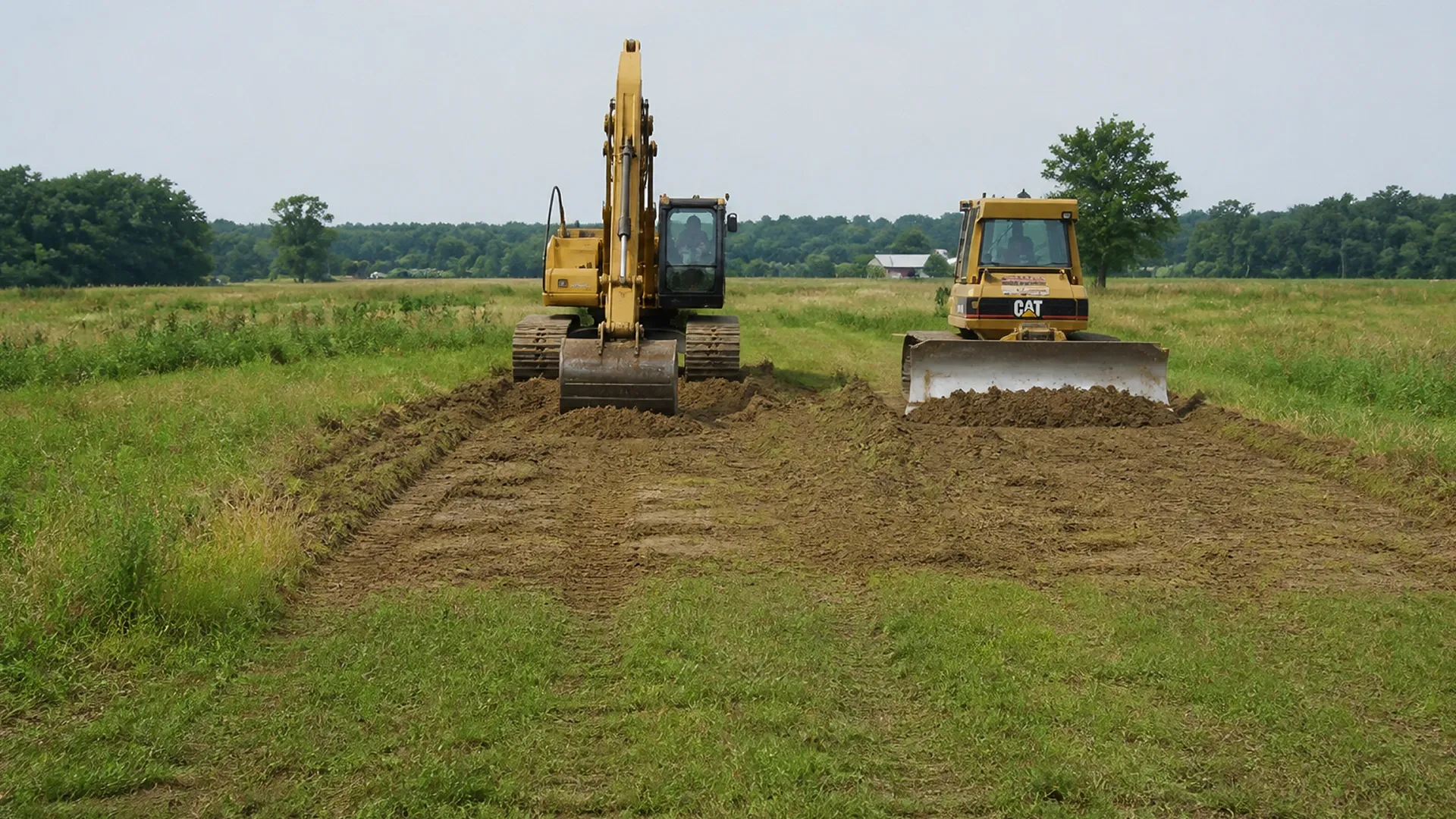
Land Grading in Polk County: What the Local Terrain Demands
Land grading in Polk County has its own set of challenges that are different from most other parts of Florida and very different from grading work in other states. Understanding this is essential before starting any drainage or site prep project in the Lakeland area.
Polk County sits on a landscape shaped by ancient lake beds. Much of the land grading in Polk County involves working with sandy soils that drain quickly in some areas but compact poorly, making it difficult to hold a consistent grade. In other areas, clay-heavy subsoil traps water at the surface. The same neighborhood can have both types within a few hundred feet of each other.
Key factors that affect land grading in Polk County:
- High water table: In many parts of Lakeland, the water table sits only 2 to 4 feet below the surface. This means deep solutions like dry wells may not work, and surface grading becomes even more critical.
- Rainy season load: Lakeland receives an average of 51 inches of rain per year, with roughly 60% falling between June and September. Your drainage system must handle intense, rapid rainfall, not just occasional showers.
- Flat elevation changes: Unlike hilly parts of Florida, Polk County has very little natural relief. Even a 2-inch elevation difference across a 50-foot yard can determine whether water drains or pools.
- Local permitting: Polk County and the City of Lakeland both require permits for significant land alteration projects that change drainage patterns. A licensed and experienced contractor will know when a permit is required and handle the process correctly.
Level One Grading serves Polk County and the greater Lakeland area with the equipment and local knowledge required to solve these site-specific challenges. Every drainage project starts with a proper site evaluation, not a one-size-fits-all estimate.
Site Grading for Drainage: The Process Step by Step
If you've decided to move forward with site grading for drainage on your Lakeland property, it helps to know what the process actually looks like. Proper site grading for drainage is not just pushing dirt around, it is a precision operation that directly determines how well your property handles rainfall for the next 10 to 20 years.
Here is what a professional site grading for drainage project typically involves:
1. Site Evaluation A crew walks the property, identifies low points, checks the current slope direction, and assesses where water is going and where it needs to go. In Lakeland, this step almost always reveals at least one issue the homeowner had not noticed.
2. Establishing the Correct Slope Using laser-level equipment, the team maps out the new grade. The goal is consistent slope away from all structures, with runoff directed toward a legal discharge point — a road swale, drainage easement, or existing stormwater system.
3. Excavation and Fill Low areas are built up with compacted fill dirt. High areas may be cut down. In some cases, the entire yard surface needs to be reworked. Compaction is critical: uncompacted fill will settle unevenly and recreate the same drainage problems within a year or two.
4. Final Grade and Cleanup The finished grade is checked against the target slope, smoothed, and prepped for sod, seed, or whatever surface treatment the homeowner is planning.
Most residential site grading for drainage projects in Lakeland are completed in one to three days, depending on lot size and complexity. Commercial or larger rural properties take longer and may involve additional permits.
French Drain vs. Regrading: Which Solution Is Right for Your Lakeland Property?
One of the most common questions homeowners ask is whether they need a French drain vs. regrading, and the answer depends entirely on what is causing the drainage problem in the first place.
The French drain vs. regrading decision comes down to this: regrading fixes the grade - French drains manage water after it gets there. Ideally, both work together. But if you install a French drain on a lot that is still graded toward your house, the drain will be overwhelmed and eventually fail.
Here is a practical comparison for Lakeland homeowners:
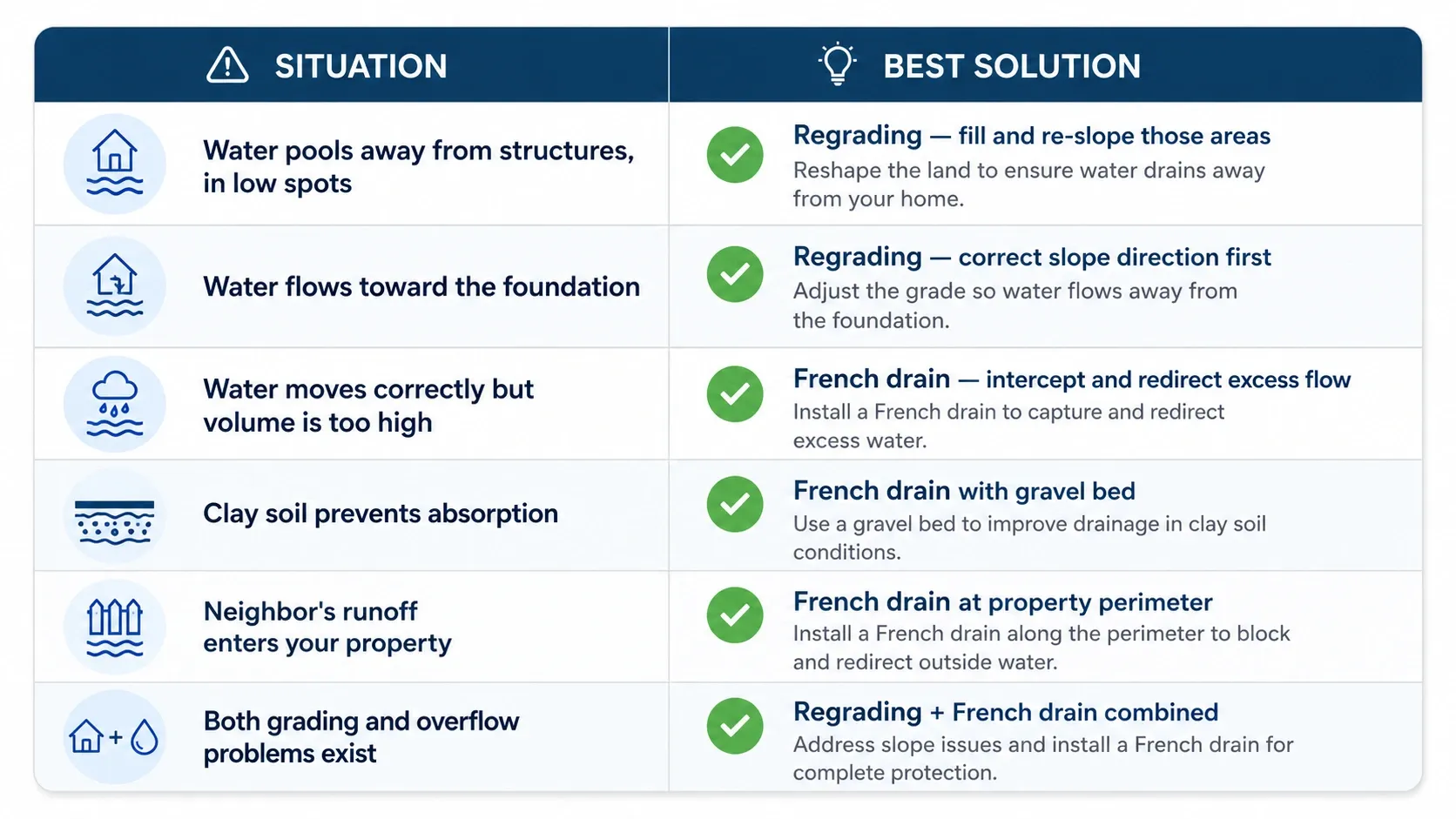
In Lakeland specifically, the most common scenario is a grading deficiency that is then partially addressed with a French drain, but the French drain was installed without correcting the grade first. This is one of the most expensive mistakes property owners make because the French drain system fails or requires constant maintenance, when the fix should have started with the earth itself.
Level One Grading assesses both factors before recommending any solution. If regrading alone will solve the problem, we say so. If a French drain is the right tool, or part of the solution, we have the experience to install it correctly.
Learn more about French drain installation in Hillsborough County →
Frequently Asked Questions About Yard Drainage in Lakeland, FL
How much does yard drainage grading cost in Lakeland, FL?
The cost of yard drainage grading in Lakeland typically ranges from $800 to $5,000 for a standard residential lot, depending on the size of the area, the severity of the grading issues, and whether fill material needs to be brought in. Properties with significant elevation problems or that require compaction work will be on the higher end. Level One Grading provides free on-site estimates so homeowners know the exact scope before any work begins.
Does Lakeland require a permit for yard regrading?
It depends on the scope of the project and your specific location within Polk County or the City of Lakeland. Minor grading that does not significantly alter drainage patterns typically does not require a permit. However, projects that change the flow of water off your property, add substantial fill, or disturb more than a certain square footage may trigger permitting requirements. A licensed contractor like Level One Grading will identify permit needs during the initial evaluation.
How long does standing water persist after regrading?
After professional regrading, most properties see standing water eliminated within the first full rain cycle. You should notice an immediate change in how water moves across the yard after a storm. It's normal for some minor settling to occur in the first few months, particularly in areas where fill was added — but the drainage pattern should be correct from day one.
Can I fix yard drainage problems myself in Lakeland?
Small adjustments — like re-leveling a garden bed or redirecting a downspout — are manageable DIY projects. However, regrading a yard involves compaction, slope calculations, and knowledge of how water moves across your specific lot. A poorly executed DIY regrading job can make drainage problems significantly worse and create new issues closer to your foundation. For anything beyond surface-level tweaks, professional site grading is the right call.
What is the best time of year to regrade a yard in Lakeland?
The best time for yard regrading in Lakeland is between November and April — the dry season. Dry ground is easier to work, equipment has better access, and the finished grade can be evaluated and adjusted before the rainy season begins in June. That said, Level One Grading can complete projects year-round when needed.
Conclusion: Stop Losing Ground to Poor Drainage
Yard drainage in Lakeland, FL is solvable and it almost always starts with getting the grade right. Whether you're dealing with a backyard that stays wet for days, water creeping toward your foundation, or chronic pooling that's killing your lawn, the fix is grading the land to work with Florida's rainfall instead of against it.
Level One Grading serves Lakeland and all of Polk County with professional site grading, land clearing, drainage solutions, and site preparation for both residential and commercial properties. Our team evaluates every property individually, because drainage problems in Central Florida are site-specific, and cookie-cutter solutions rarely hold up through a full rainy season.
Ready to solve your yard drainage problem for good? Contact Level One Grading (813) 842-4840 - for a free on-site estimate. We'll walk your property, identify exactly what's causing the issue, and give you a clear plan, no pressure, no guesswork.

About Miguel Orozco
Miguel Orozco is the President of Level One Grading, a trusted Central Florida grading and excavation company, delivering precise earthwork solutions and dependable results for residential and commercial projects since its founding.