
What Equipment Is Used for Land Clearing Services in Florida?
Professional land clearing services require the right equipment and a precise grading process. See how Level One Grading gets your site construction-ready.

Miguel Orozco

If you've ever driven past an active construction site in the early stages, you've seen it, heavy machines moving across raw land, pushing trees, pulling stumps, and reshaping terrain in ways that look almost effortless from the road. What you're watching is professional land clearing services in action, and the equipment doing that work is more specialized than most people realize.
Understanding what equipment goes into land clearing services and why each piece matters, helps property owners and developers make more informed decisions when hiring a contractor. It also explains why land clearing services cost what they do, and why the difference between a well-equipped team and an underprepared one shows up clearly in the results.
This article walks through the primary equipment used in professional land clearing services, explains the step-by-step grading process that follows, and shows why the combination of the right tools and the right process is what makes a cleared site truly ready for construction.
Heavy Excavation Equipment Used in Land Clearing Services
Professional land clearing services require different types of excavation equipment depending on the size of the site, the density of vegetation, and the soil conditions. A reputable land clearing company arrives with the right machines for your specific project, not whatever happens to be available.
Here is the core excavation equipment used in professional land clearing services:
Bulldozer (Crawler Dozer)
The bulldozer is the workhorse of land clearing services. Equipped with a large, hydraulic front blade, a dozer pushes trees, stumps, brush, and debris across the site and into piles for removal or burning. Modern dozers used in land clearing services are available in different blade configurations, including straight blades for pushing and angle blades for side-casting material, allowing operators to adapt to different clearing conditions.
For land clearing services in Florida, dozers with lower ground pressure configurations are often preferred because standard dozers can sink into soft sandy or organic soils. Track width and undercarriage configuration matter significantly in Florida's soil conditions.
Forestry Mulcher
For land clearing services where stump and root removal isn't required, such as right-of-way clearing or sites where grinding in place is preferable to excavation, a forestry mulcher is highly efficient. This piece of excavation equipment mounts on a skid steer or tracked carrier and uses high-speed rotating drum teeth to reduce trees, brush, and stumps to mulch in a single pass.
Forestry mulchers are particularly useful in land clearing services for smaller residential lots or sites where access is limited, because they can maneuver in tight spaces that larger dozers cannot reach.
Excavator
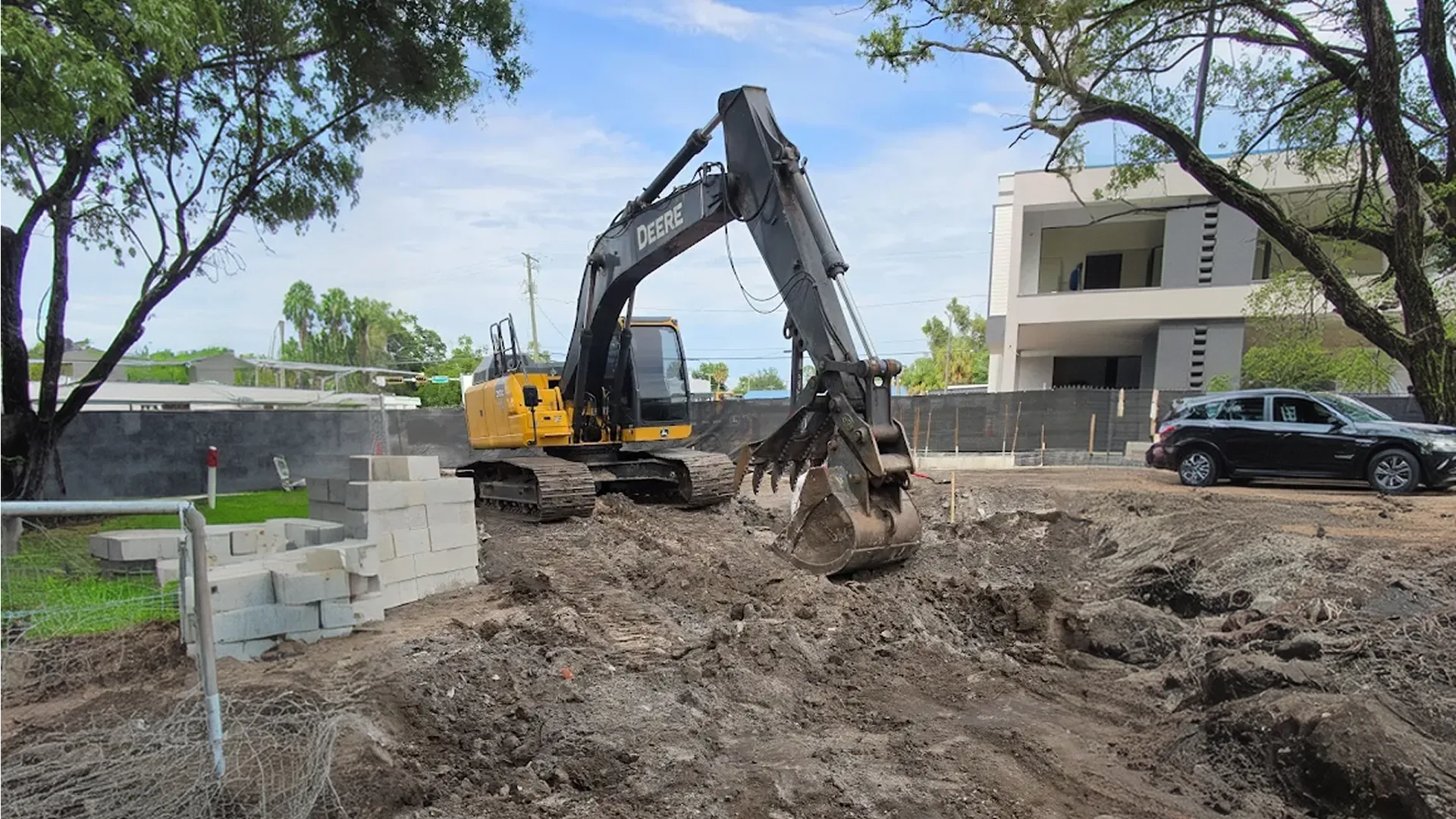
An excavator is the most versatile piece of excavation equipment in a land clearing services operation. With its 360-degree rotation and interchangeable attachments, including grapples, rakes, shear blades, and stump buckets, an excavator can grab individual trees and pull them with their root systems intact, sort debris for disposal, load trucks, and dig drainage features all within a single mobilization.
For land clearing services that involve precise root extraction, essential when preparing a site for a foundation pour, an excavator is the preferred tool because it allows the operator to remove stumps and roots with surgical accuracy rather than rough-pushing everything.
Skid Steer Loader
In land clearing services, the skid steer serves as a highly mobile cleanup and detail machine. After larger excavation equipment has handled the bulk of clearing, skid steers equipped with grapple buckets, brush cutters, or rock rakes complete the site cleanup, removing remaining debris, grading small areas, and cleaning up around structures or boundaries that larger machines can't safely approach.
Dump Trucks and Haul Equipment
Land clearing services generate enormous volumes of material — trees, stumps, brush, topsoil, and demolition debris. Professional land clearing services include haul equipment to remove this material from the site, either to a disposal facility, a chipping and mulching operation, or a licensed burn site where local regulations permit.
The Step-by-Step Grading Process After Land Clearing Services
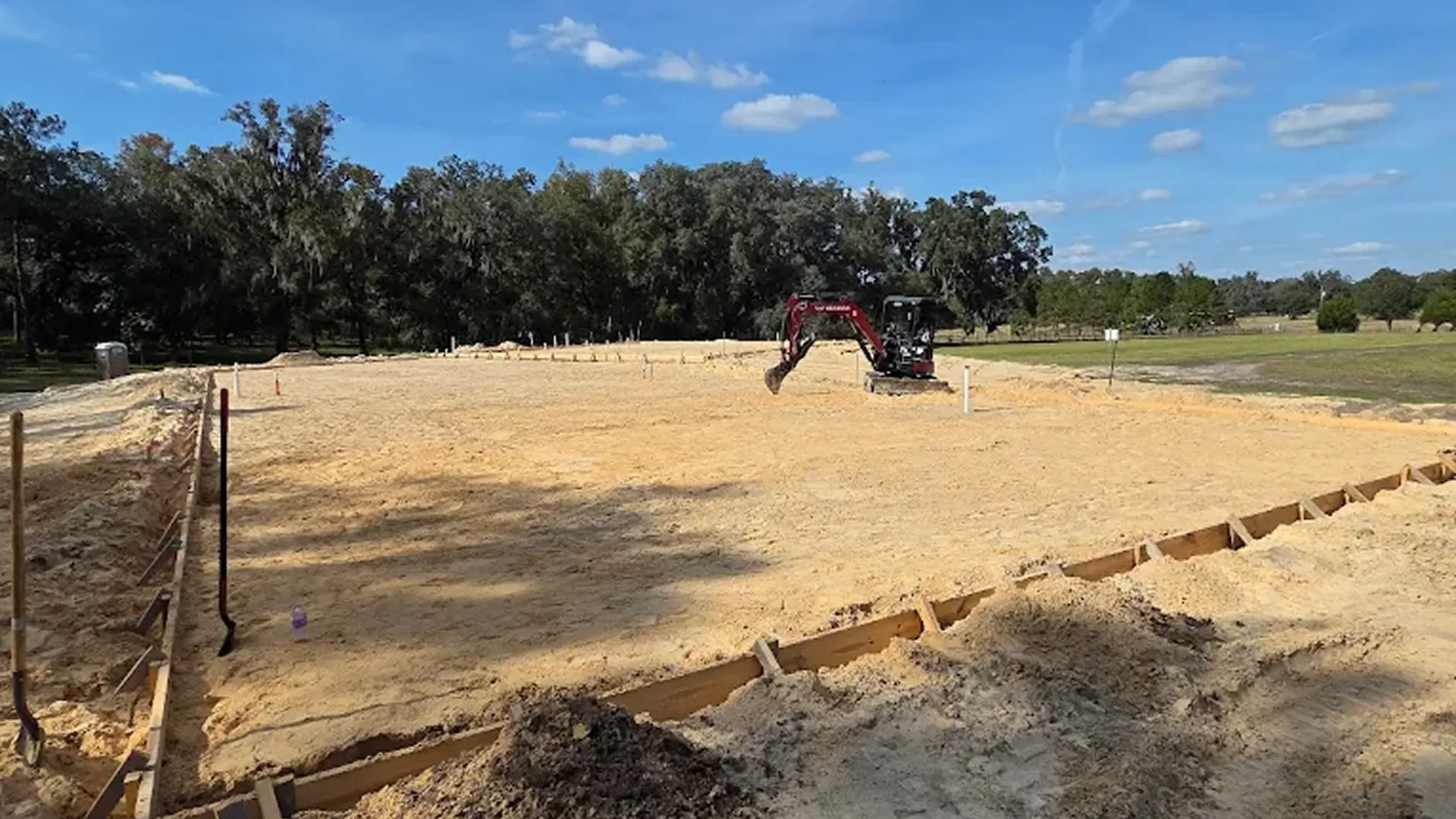
Land clearing services are the first phase of site preparation, but they're not the last. Once vegetation and debris are removed, the grading process begins. This is where the site is shaped, compacted, and prepared to support construction.
Here is the grading process as it follows land clearing services on a typical Central Florida project:
Step 1: Survey and Staking
Before any grading equipment moves, the site is surveyed and staked according to the engineered site plan. Survey stakes establish the target elevations, building setbacks, drainage swale locations, and boundary points that the grading process will follow. This step ensures that the grading process produces a site that matches the approved construction plan, not just a flat piece of land.
Step 2: Rough Grading
Using motor graders, bulldozers, and scrapers, the grading process begins with establishing the rough elevations across the site. Cut areas, where existing soil is above the target grade, are excavated. Fill areas, where the existing grade is below target, receive compacted fill material. The goal at this stage of the grading process is to get the overall site within a few inches of the finished plan.
Step 3: Subgrade Compaction
Once rough grades are established, the subgrade, the layer of soil directly below the finished surface, is compacted using vibratory rollers or plate compactors. Compaction is one of the most critical steps in the entire grading process because it determines the bearing capacity of the soil. In Florida's sandy soils, achieving the required compaction density (typically 95–98% of Standard Proctor density) requires multiple passes and careful moisture control.
Step 4: Utility Trenching and Installation
During or immediately after the grading process reaches subgrade, underground utilities, water lines, sewer laterals, electrical conduits, and drainage pipes, are trenched in, installed, and backfilled. Coordinating utility installation with the grading process prevents the finished grade from being disturbed after compaction is complete.
Step 5: Fine Grading
After utilities are in place, the grading process moves into fine grading, the precise shaping of the surface that establishes drainage patterns, slab elevations, pavement slopes, and landscaping grades. This is the most precise phase of the grading process, where tolerances are measured in fractions of an inch rather than inches.
Step 6: Final Compaction and Testing
The finished grade is compacted to final specification, and compaction testing is performed by a licensed geotechnical firm to confirm the soil meets the structural requirements of the construction plan. Compaction test results are typically required by the building department before foundation work can begin. This final step in the grading process closes out the site preparation phase and opens the way for construction.

Why the Right Equipment and Process Protect Your Investment
Hiring land clearing services without the right excavation equipment, or with a team that doesn't follow a proper grading process, creates problems that aren't visible until construction is underway or complete.
Underpowered equipment leaves root systems in place that decompose over time, creating voids beneath foundations. Incomplete stump removal in the path of utility trenches causes cave-ins and pipe failures years after installation. A grading process that skips compaction testing produces a site that fails inspection or, worse, passes inspection and fails structurally once a building load is applied.
Professional land clearing services followed by a disciplined grading process are not about doing more than necessary, they're about doing exactly what is necessary to ensure the site performs as designed. Every piece of excavation equipment in a well-run operation is there for a specific reason, and every step in the grading process builds on the one before it.
Frequently Asked Questions About Land Clearing Services
What is included in professional land clearing services?
Professional land clearing services include the removal of all vegetation (trees, stumps, shrubs, roots), debris removal and hauling, brush clearing, and site cleanup to prepare the lot for grading. In Florida, land clearing services may also include compliance with local tree ordinances, which require surveying protected species before clearing begins and obtaining removal permits for specified tree types and sizes. A complete land clearing services package leaves the site free of above-ground and below-ground organic material that would interfere with grading, compaction, or construction.
How long do land clearing services take in Florida?
The timeline for land clearing services in Florida depends on the size of the property and the density of vegetation. A standard residential lot of 0.5 to 1 acre with moderate tree cover can be cleared in 1 to 3 days with a properly equipped crew. Larger commercial sites of 5 to 20 acres may require 1 to 2 weeks of land clearing services, depending on access conditions, debris volume, and disposal method. Florida's protected species requirements can add time to the early planning phase of land clearing services if protected trees must be identified and permits obtained before clearing begins.
What is the difference between land clearing services and grading?
Land clearing services and grading are two distinct but sequential phases of site preparation. Land clearing services remove what's on and just below the surface — trees, stumps, brush, roots, and debris, leaving the site bare. The grading process then shapes, levels, and compacts the cleared soil to the engineered elevations required for construction. You cannot properly grade a site that hasn't been cleared, and cleared land that isn't graded isn't ready for construction. Professional land clearing services and grading work together as a complete site preparation system.
Conclusion: Equipment and Process Are What Separate Professional Land Clearing Services From the Rest
The difference between land clearing services done right and land clearing services done poorly isn't always visible the day the equipment leaves your site. It shows up months later, in soil that settles unevenly, roots that decompose and create voids, or drainage problems that couldn't have been predicted without a proper grading process.
At Level One Grading, our site preparation services rely on the use of excavation equipment suited to Florida’s soil conditions and a grading process that ensures every site is fully prepared for construction. From the moment the first machine arrives on site to the final compaction test, every step is performed according to specifications, so your construction project can begin on a site you can trust. Contact our team today: (813) 842-4840!

About Miguel Orozco
Miguel Orozco is the President of Level One Grading, a trusted Central Florida grading and excavation company, delivering precise earthwork solutions and dependable results for residential and commercial projects since its founding.