
How Proper Grading and Culvert Installation Prevent Washed-Out Driveways in Central Florida
Stop driveway washouts with proper culvert installation and crowning in Central Florida. Contact Level One Grading for a free site estimate today.

Miguel Orozco

For rural and semi-rural property owners in Hillsborough, Polk, and Pasco counties, a washed-out driveway is a recurring nightmare during Florida's summer monsoon season. Heavy subtropical downpours can transform a smooth gravel or crushed concrete driveway into a treacherous obstacle course of deep ruts, gullies, and standing water in less than an hour.
When water tears apart your driveway, the instinct is often to dump another load of rock or fill into the ruts. However, simply adding material without addressing the underlying water flow only creates an expensive cycle of repeated repairs. The permanent solution lies in two interconnected civil practices: precision driveway crowning and grading, paired with properly engineered culvert pipe installation.
In this comprehensive guide, Level One Grading breaks down why driveway washouts happen in Central Florida, how culverts function as the first line of defense, and the engineering principles required to build an all-weather access road that withstands severe storms.
Why Central Florida Driveways Wash Out So Quickly
Central Florida terrain presents unique challenges for unpaved and aggregate driveways:
- Intense Rainfall Rates: Tropical depressions, convective summer storms, and afternoon thunderstorms frequently dump 2 to 4 inches of rain in under two hours across the I-4 corridor.
- Sandy, Erodible Native Soils: Native Florida soils, predominantly fine marine sands (AASHTO A-3 classification), offer virtually zero natural cohesion when exposed to turbulent sheet flow.
- Flat Regional Topography: With minimal natural elevation changes across Hillsborough and Polk counties, stormwater does not drain away on its own unless intentional slopes and ditches are cut into the land.
- Inadequate or Collapsed Culverts: Driveway entrances that cross roadside drainage swales without a correctly sized culvert act like dams. During peak storms, stormwater backs up, overflows the road, and scours away surface aggregate.
The Critical Role of Culvert Pipe Installation
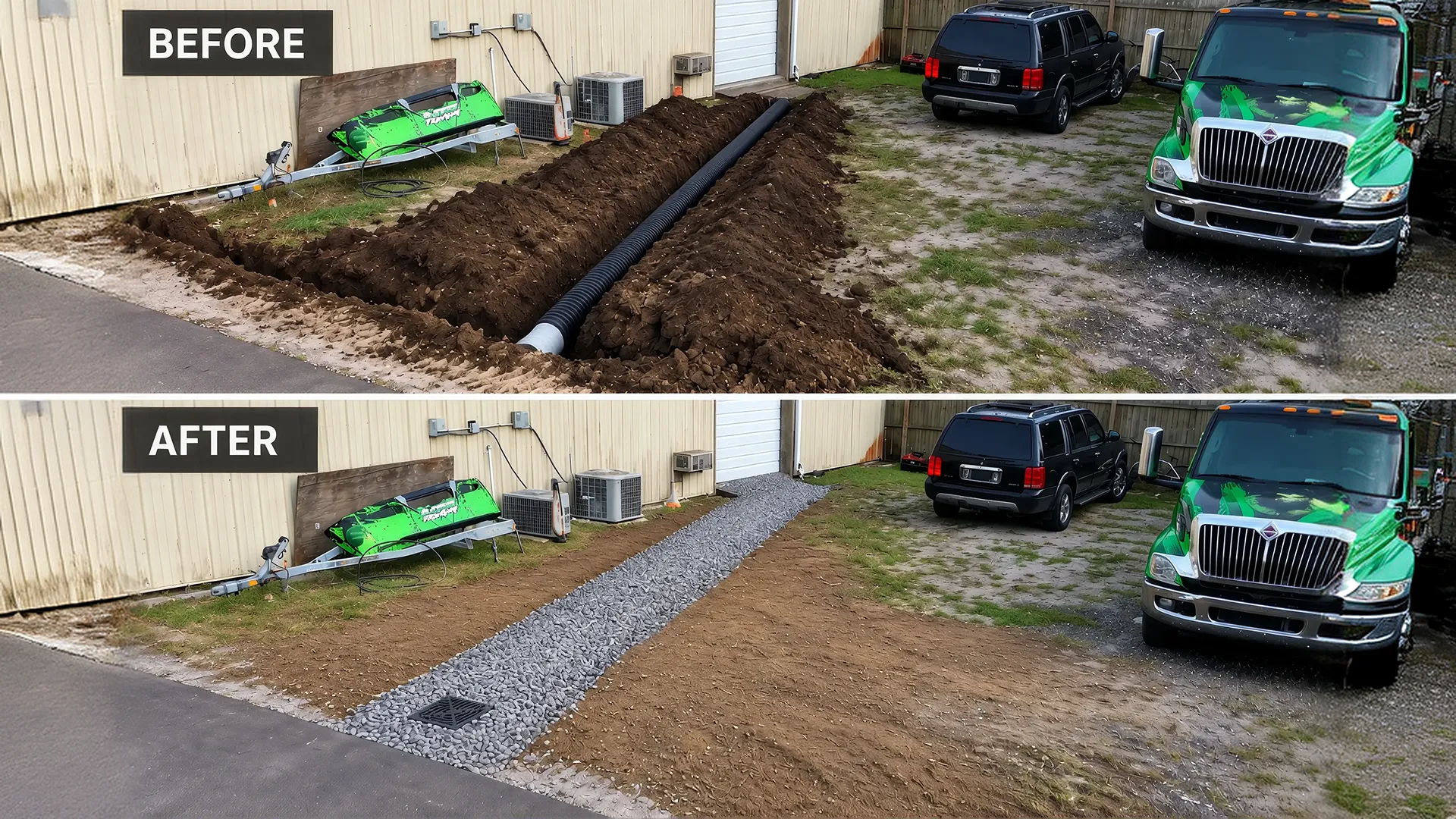
A driveway culvert is an engineered underground conduit that allows ditch and swale water to flow unimpeded beneath your driveway entrance where your property connects to county roads or private easements.
Sizing and Pitch Matter
Installing whatever scrap pipe is cheapest at the local supply yard is the leading cause of culvert failure in Florida. Several technical factors dictate proper culvert specifications:
- Pipe Diameter: Most residential crossings across Central Florida require a minimum 15-inch to 18-inch diameter pipe. In agricultural acreage or areas receiving regional ditch runoff, 24-inch or 36-inch pipes may be necessary to handle 25-year storm volumes.
- Flow Elevation (Invert): The pipe invert (the inside bottom elevation) must match the upstream ditch flowline exactly. Setting the pipe too high creates permanent stagnant ponds; setting it too low allows silt, sand, and organic muck to rapidly clog the pipe.
- Slope Gradient: A continuous 0.5% to 1.0% downward slope ensures stormwater maintains self-cleaning hydraulic velocity without eroding the downstream outfall bank.
- Pipe Material Selection: While corrugated galvanized metal pipe was historically common, acidic Florida soils and standing wetland water accelerate rust. Today, Level One Grading installs dual-wall high-density polyethylene (HDPE) smooth-interior pipe or reinforced concrete pipe (RCP) for maximum structural longevity.
Mitered End Sections and Headwalls
Unprotected pipe ends quickly erode under torrential flows. Utilizing concrete headwalls or Florida Department of Transportation (FDOT) approved mitered end sections stabilizes the ditch bank, prevents vehicle wheel drop-off damage, and keeps soil from caving into the pipe entrance.
Precision Grading: Crowning and Shoulder Slopes
Even the best culvert will not save a driveway if the driving surface itself is flat or dished out in the center. When water stands on the road surface, vehicular traffic creates hydraulic pressure that liquefies the aggregate base, leading to rapid potholes.
Establishing the Center Crown
A well-graded driveway should never be completely flat. It must feature a pronounced center crown -- a smooth inverted 'V' or parabolic arc sloping downward from the centerline to both shoulders at a rate of 1/2 inch to 3/4 inch per foot (a 4% to 6% cross slope). This ensures rainwater sheds off the driving surface immediately into side swales rather than traveling down the vehicle tire tracks.
Compaction and Base Material Selection
Water erosion accelerates when driveway base aggregate is loose or contaminated with sand:
- Crushed Concrete Base: An exceptional, budget-friendly recycled base that compacts into a hard, cohesive crust when wetted and rolled.
- FDOT Certified Limerock: The standard commercial road base across Florida, offering immense load-bearing strength when compacted to 98% density.
- Asphalt Millings: Recycled asphalt that binds together under heavy vehicle traffic and summer heat, creating an oil-bound, dust-free surface.
Utilizing heavy vibratory smooth-drum rollers compacts road base into a dense, interlocking matrix that resists tire displacement and hydraulic scouring.
Right-of-Way Permitting in Central Florida
Before installing or replacing a culvert that connects to a public road, county regulations must be observed:
- Hillsborough County: Requires a Right-of-Way (ROW) driveway permit, specifying culvert sizing based on county stormwater models.
- Polk County: Requires a Driveway Connection Permit through the Roads & Drainage Division.
- Pasco County: Requires engineering review for culvert elevations within county maintenance easements.
Level One Grading handles the elevation survey, pipe sizing calculation, and permit coordination so your new driveway entrance passes county inspection without delay.
Step-by-Step Driveway Restoration Process
When Level One Grading repairs or installs an access road in Central Florida, we follow a rigorous six-step civil sequence:
- Topographic & Flow Assessment: We survey the natural drainage path, measure upstream ditch flowlines, and verify county permit guidelines.
- Subgrade Stripping: Soft muck, standing vegetation, and silted ruts are cut out down to firm, unyielding mineral subsoil.
- Culvert Trenching & Bedding: The trench is laser-graded with aggregate bedding to prevent pipe settling or joint separation.
- Sub-Base Crowning: Machine-guided grading shapes the centerline crown and cuts drainage swales on either side of the road.
- Commercial Base Installation & Lifts: Crushed concrete or commercial base rock is spread and compacted in controlled moisture lifts.
- Final Grade & Tie-In: Smooth transitions to the roadway and garage pads ensure safe, bump-free access for passenger cars and heavy delivery trucks.
Frequently Asked Questions About Florida Driveway Drainage
How do I know if my driveway culvert is too small?
If water consistently overflows your driveway during afternoon thunderstorms while the downstream ditch still has capacity, your culvert diameter is undersized or partially choked with sediment.
Can I just pour gravel into the ruts to fix my driveway?
Dumping loose gravel into un-graded ruts is a temporary band-aid. Without cutting the ruts out and reshaping the center crown, the next heavy downpour will wash the loose gravel into the side ditches, wasting your money.
What is the best material for a rural Florida driveway?
Crushed concrete and compacted limerock are the top two choices. Both materials lock together when properly compacted with a vibratory roller, forming a concrete-like slab that sheds water and resists tire gouging.
Stop Re-Buying Gravel Every Rainy Season
A washed-out driveway is not bad luck; it is a grading and drainage failure. By investing in proper culvert placement, precision center crowning, and mechanical compaction, you protect your vehicles, maintain emergency access, and preserve your property value year-round.
Contact Level One Grading today for a site inspection and free estimate on driveway restoration, crowning, and culvert installation across Plant City, Lakeland, Tampa, and surrounding Central Florida counties.

About Miguel Orozco
Miguel Orozco is the President of Level One Grading, a trusted Central Florida grading and excavation company, delivering precise earthwork solutions and dependable results for residential and commercial projects since its founding.